El mago
Cruzando la quebrada desde el molino hay un terreno
donde los gitanos dejan el burro atado al árbol. A veces
atravieso el río, le llevo una manzana, y se la ofrezco
como una piedra preciosa. Él la contempla, luego toma mi mano
entera entre los labios de gamuza, y no sé cómo
pero cuando levanta la cabeza la fruta ya no está.
The Magician
Across the ravine from the mill house there’s a grassy patch
where gypsies keep a donkey tied to a tree. Sometimes
I’ll cross the stream and bring him an apple, holding it out
like a rare jewel. He’ll contemplate it, then take my whole
hand into his lips as soft as suede, and I can’t tell how he
does it, but when his head lifts back, the apple has disappeared.
Noche de día
La noche no quiere terminar, nunca quiere entregarse
a la luz. Así que se esconde en las cosas: cuervos, obsidiana.
Hasta en el solsticio de verano, día en que la luz tiene
su gran triunfo, donde campos de girasoles devoran el sol:
partimos la sandía y escupimos
semillas negras, pedazos de noche que relucen en el pasto.
Night in Day
The night never wants to end, to give itself over
to light. So it traps itself in things: obsidian, crows.
Even on summer solstice, the day of light’s great
triumph, where fields of sunflowers guzzle in the sun —
we break open the watermelon and spit out
black seeds, bits of night glistening on the grass.
The night never wants to end, to give itself over
to light. So it traps itself in things: obsidian, crows.
Even on summer solstice, the day of light’s great
triumph, where fields of sunflowers guzzle in the sun —
we break open the watermelon and spit out
black seeds, bits of night glistening on the grass.
Los disturbios recurrentes del verano
Finales de primavera y las capuchinas se portan bien,
las hojas apenas salen de las macetas. Pero sé que falta poco –
esta mañana noté que el primer brote se asomaba, vacilante,
hacia la luz que inunda el jardín, y veo cómo las cabezas luminosas
susurran entre las hojas – pronto van a salir disparadas, pronto
los tallos van a escapar por la terraza, en enjambre, yéndose para la luz.
Every Summer the Riots
Late spring and the nasturtiums are behaving themselves, just poking
their leaves over the flower box. But I know it won’t be long now —
this morning I noticed the first tentative shoot peering out
to where sunlight floods the garden, and I can see the jeweled heads
whispering in the leaves — soon they’ll make a break for it, soon
the tendrils will bolt across the deck, swarming toward light.
Perdido
El ciervo se da vuelta y sigue tranquilamente
cuesta arriba sin mirar siquiera
hacia donde estoy yo, donde empiezo a cruzar
un campo nevado dentro de mi cuerpo y me pierdo
mientras una ceniza blanca cae del cielo y tapa mis huellas
y no hay cómo encontrar el camino de vuelta.
Lost
The deer turns his head away from me and casually
continues along the ridge not even glancing back
to where I stand, to where I begin to walk across
a field of snow inside my body and lose myself
as a white ash drifts from the sky filling my tracks
and there is no way to find my way back.
La traducción difícil del amor
Pasados cinco años de matrimonio,
pensó que su corazón había logrado traducirlo.
Pero fue como esa noche en el Ciclo de Cine Extranjero
cuando de pronto en mitad de una película
los subtítulos cambiaron a doblaje
y por un instante pensó que entendía rumano.
Love’s More Difficult Translation
About five years into the marriage
he thought his heart had finally translated it.
But it was like that night at the Foreign Film Festival
halfway through a movie when suddenly
it switched from subtitles to dubbed English
& for an instant he thought he understood Romanian.
Canción de divorcio
Amargo el calor del sol, amargos el sabor a manzana,
la canción, las estrellas y los campos de trigo, amargos el recuerdo,
la luna, la superficie del lago a la mañana con su resplandor
como de perla, amargos la garganta del colibrí
y el polen dorado, todos los poemas y su música, maderas
de arpa y sándalo, amargos, sábanas de seda, fuego, el matrimonio.
The Song of Divorce
Bitter the warmth of sunlight, and bitter the taste of apple,
the song and the stars and wheat fields, bitter the memory,
moonlight, the shine of the lake’s surface in morning
like a sheen of pearl, bitter the hummingbird’s throat
and gold pollen, all poems and their music, harp wood
and sandalwood, bitter, silk sheets, fire, the marriage.
(De Suite for the common).
Traducción: Shira Rubenstein, bajo el cuidado de Laura Wittner.
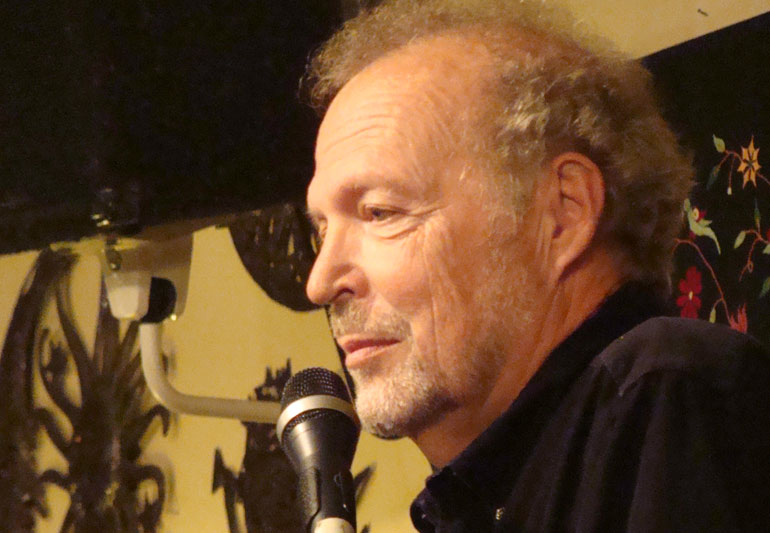
Joseph Stroud es autor de cinco libros de poesía: In the Sleep of Rivers (Capra Press,1974), Signatures (BOA Editions, 1982), Below Cold Mountain (Copper Canyon Press,1998), Country of Light (Copper Canyon Press, 2004) y Of This World, New & Selected Poems (Copper Canyon Press, 2009). Ha recibido numerosos premios y honores a lo largo de su carrera literaria. Actualmente divide su tiempo entre una casa en Santa Cruz en la costa de California, una cabaña en la Sierra Nevada y un pequeño estudio en los cerros de Jalisco, México.
(De Suite for the common).
Traducción: Shira Rubenstein, bajo el cuidado de Laura Wittner.
Joseph Stroud es autor de cinco libros de poesía: In the Sleep of Rivers (Capra Press,1974), Signatures (BOA Editions, 1982), Below Cold Mountain (Copper Canyon Press,1998), Country of Light (Copper Canyon Press, 2004) y Of This World, New & Selected Poems (Copper Canyon Press, 2009). Ha recibido numerosos premios y honores a lo largo de su carrera literaria. Actualmente divide su tiempo entre una casa en Santa Cruz en la costa de California, una cabaña en la Sierra Nevada y un pequeño estudio en los cerros de Jalisco, México.

